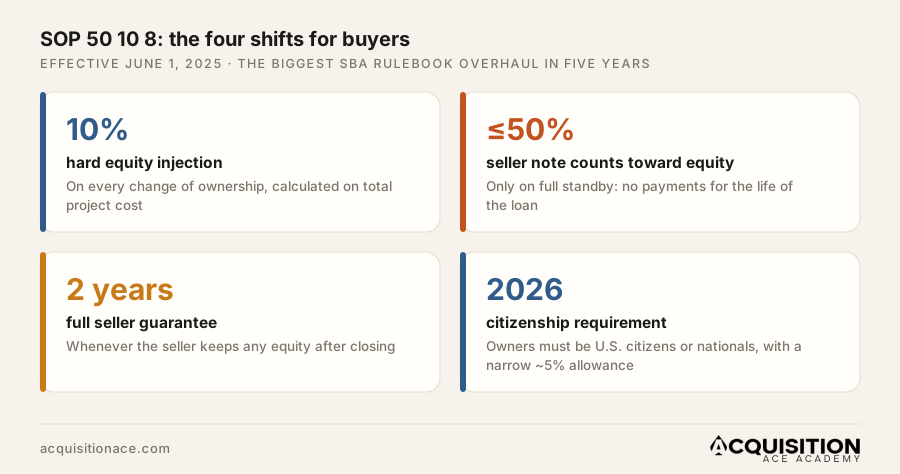
The short answer: SOP 50 10 8 (effective June 1, 2025) is the SBA's rulebook for 7(a) and 504 loans and the biggest overhaul in five years. For buyers, the big shifts are: a hard 10% equity injection on every change of ownership, seller notes counting toward equity only on full standby (≤50% of the injection), a full seller guarantee for two years if any equity is kept, and a 2026 citizenship requirement for owners. SOP 50 10 8.1 (loans numbered on or after October 1, 2026) tightens it further: the DSCR floor rises to 1.25× on historical cash flow (projections no longer count), a Quality of Earnings report is mandatory at $3M+ purchase prices, and the streamlined small-loan path (with its SBSS screen) is gone for acquisitions. The 10% injection and the standby seller note rules carry over unchanged. We track live updates on the SBA rule tracker.
The 8.1 update: what moved on October 1, 2026
SOP 50 10 8.1 (announced August 14, 2026, SBA Information Notice 5000-880695) applies to every loan issued an SBA loan number on or after October 1, 2026. Files numbered through September 30 stay under 50 10 8. For buyers, the core injection math survived; the underwriting around it got stricter:
| Area | Under 50 10 8 | Under 50 10 8.1 |
|---|---|---|
| Equity injection | 10% of total project cost; up to half from standby seller notes | Unchanged. 10% minimum; standby notes, standby debt and small minority investors together still cap at 50% of the injection |
| DSCR floor | 1.15×, projections could fill the gap for first-time buyers | 1.25× for acquisitions and owner buyouts, measured on historical cash flow only; projections do not count |
| Quality of Earnings | At the lender's discretion | Mandatory at $3M+ purchase price, with a cash proof covering the trailing 12 months and two fiscal years |
| Small-loan path | Deals ≤$350K could run streamlined, screened by the SBSS score | Gone for changes of ownership: every acquisition runs full standard 7(a) underwriting; SBSS is being sunset for 7(a) small loans |
| Loan sizing | Sized to the appraisal in practice | Codified: total debt is capped at the appraised business value |
| Seller involvement | Consultant up to 12 months; seller-note refi seasoning 24 months | Consultant up to 24 months; seasoning 36 months |
The figures above are corroborated across independent practitioner summaries of the issued SOP; the SOP text itself governs. If your loan number was issued before October 1, your file stays under the old rules.
What SOP 50 10 8 is
The "SOP" (Standard Operating Procedure) is the giant manual that tells SBA lenders how to originate and process loans. Version 50 10 8 took effect June 1, 2025, and rolled back much of the looser policy from prior years, tightening who qualifies, how much you put down, and how deals are structured. Several provisions were then adjusted through follow-up procedural and policy notices into 2026.
The rulebook got stricter and clearer. For a prepared buyer, clarity is an advantage.
What changed, by topic
1. Equity injection
A hard 10% minimum equity injection now applies to every complete change of ownership, including startups under a year old. ESOPs are exempt. At least half must be the buyer's own equity; up to half can be a full-standby seller note. Deep dive: down payment & equity injection.
2. Seller notes
Seller notes count toward the injection only if on full standby for the life of the loan, capped at 50% of the required injection, and documented on SBA Form 155. A note that pays current interest no longer counts as equity. Deep dive: seller notes on full standby.
3. Guarantees & the seller's exit
A seller who retains any ownership (even 1%) must give a full personal guarantee for at least two years. In practice this pushes most deals toward a clean seller exit to 0%. Deep dive: personal guarantee (& spouses).
4. Partial ownership & expansions
Partial buyouts (buying part of a business, or a partner buying out another) got tighter treatment. But the SBA also kept a helpful exception: buying a business under the same 6-digit NAICS code with identical ownership is treated as an expansion, not a change of ownership, so the 10% minimum injection does not apply. Deep dive: partial buyouts & equity rollover.
5. Citizenship & residency
For loans approved on/after January 1, 2026 (policy effective March 1, 2026 for nondelegated loans), the SBA generally requires owners to be U.S. citizens or U.S. nationals, with a limited ~5% allowance for certain others. This evolved via notices, confirm the current rule with your lender. Deep dive: the 2026 citizenship rule.
Before vs. now, at a glance
| Topic | Before | Under SOP 50 10 8 (2025 to 2026) |
|---|---|---|
| Equity injection | Often 10%, some flexibility | Hard 10% floor, all changes of ownership |
| Seller note as equity | Standby terms varied | Full standby, life of loan, ≤50% of injection, Form 155 |
| Seller keeping equity | More flexibility | Full PG for 2 yrs → most sellers exit to 0% |
| Citizenship | Certain non-citizens allowed | U.S. citizens/nationals; ~5% allowance (2026) |
| Same-NAICS expansion | Treated as acquisition | Expansion, no minimum injection |
Policy is still moving
Several 50 10 8 provisions were amended by procedural and policy notices across 2025 to 2026. Treat this page as a plain-English map, not the final word, confirm the current rule with your lender, and watch the SBA rule tracker.
What buyers should do about it
- Budget a true 10% of total project cost, and plan how much is cash vs. standby note.
- Negotiate the seller note as full standby up front so it counts as equity.
- Plan the seller's clean exit to avoid the two-year guarantee trap.
- Confirm citizenship/ownership for every 20%+ owner before applying.
- Re-check your numbers in the SBA loan calculator and DSCR calculator.
Stay current on the rules
We keep a running log of SBA policy changes as they land.
The equity injection under SOP 50 10 8 and 8.1, in one place
Three phrasings of the same worry dominate buyer searches, so here they are, answered plainly. For a complete change of ownership, the minimum equity injection is 10% of total project cost, the purchase price plus financed fees and costs, not 10% of the loan. The injection cannot come from borrowed funds unless the borrowing is serviced by outside income, which is the rule that catches HELOC-funded down payments. And up to half of the injection can be a seller note on full standby for the life of the loan. The worked math lives on the down payment and equity injection page. SOP 50 10 8.1 keeps all of this unchanged: the 10% minimum and the 50% cap on standby-note equity both carry over.
Related answers: what is the SBSS score and can it kill an approved loan · why lenders change terms before closing · how many lenders to talk to · can seller financing count as your down payment.
Frequently asked questions
The SBA's update to its lending rulebook, applying to loans issued an SBA loan number on or after October 1, 2026. For buyers it raises the DSCR floor to 1.25× on historical cash flow, makes a Quality of Earnings report mandatory at $3M+ purchase prices, and ends streamlined small-loan underwriting for acquisitions. The 10% equity injection and standby seller note rules are unchanged.
The SBA's Standard Operating Procedure for 7(a) and 504 loan origination, effective June 1, 2025, the biggest overhaul of SBA lending rules in about five years.
A hard 10% equity injection on every change of ownership, seller notes counting as equity only on full standby (≤50%), a full seller guarantee for two years if any equity is kept, and a 2026 citizenship requirement.
June 1, 2025. Related ownership and citizenship provisions phased in through notices, with the citizenship rule generally applying to loans approved on or after January 1, 2026.
Yes, a hard 10% minimum on every complete change of ownership (including startups under a year old), ESOPs exempt. At least half is your own equity; up to half a full-standby seller note.
Sources
- SBA SOP 50 10 8 (effective June 1, 2025) and follow-up procedural/policy notices, sba.gov 7(a) program.
- SBA Information Notice 5000-880695, Issuance of SOP 50 10 8.1 (announced August 14, 2026; effective October 1, 2026), sba.gov.
- Plain-English change summaries, Starfield & Smith, NAGGL, Windsor Advantage, Live Oak Bank, Pioneer Capital Advisory, PilieroMazza, Doeren Mayhew, Coleman Report (2025 to 2026).