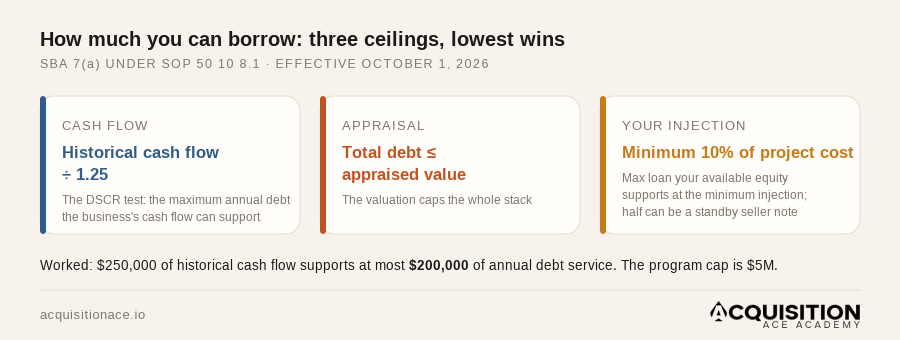
The $5M program cap is not your limit. Three ceilings are: the cash-flow test, the appraisal, and the project size your equity injection supports. The lowest test wins. The SBA 7(a) program caps loans at $5 million, but your actual borrowing limit may be lower. It depends on three things: how much debt the business's historical cash flow can support (the total loan's debt service must be covered 1.25 times under SOP 50 10 8.1), how much debt its appraised value permits, and how much you can finance given your available equity and the minimum 10% injection requirement, up to half of it coverable by a standby seller note. Each test produces a maximum loan amount, and whichever produces the lowest one sets your limit.
The components of the three ceilings, in order
| Ceiling | The rule | When it binds |
|---|---|---|
| Cash flow | Historical cash flow ÷ 1.25 ≥ annual debt service (DSCR) | Most deals: it is the first test every desk runs |
| Appraisal | Total debt capped at the appraised business value | When the price ran ahead of what the appraiser can support |
| Injection | Minimum 10% of total project cost, half coverable by a standby note | When your cash, not the deal, is the constraint |
| Program cap | $5M maximum 7(a) exposure | Rarely, at the top of the market |
Notice what is not on the list: your income, your projections for the business, and the broker's cash-flow addbacks. Lenders size acquisition loans from the business's verified history, and under SOP 50 10 8.1 (effective October 1, 2026) projections explicitly cannot fill a historical shortfall.
The worked example
| Ceiling | The math | Maximum loan amount |
|---|---|---|
| Cash flow | $250,000 verified historical cash flow ÷ 1.25 = $200,000 of annual debt service | The loan that $200,000 a year carries at your quoted rate and term |
| Appraisal | Total debt capped at the appraised business value | Known when the appraisal comes back; a price above it does not get financed |
| Injection | $100,000 available equity covers the minimum 10% of a $1,000,000 total project (up to $50,000 of it as a standby seller note) | ~$900,000 |
The cash-flow row deliberately stops at annual debt service, and that is the honest part: converting it into a loan amount depends on the rate and term you are quoted, which is why the same business supports different loan sizes at different desks, and why talking to several lenders changes the answer to this page's question.
The same math at three deal sizes
| Historical cash flow | Max annual debt service | Injection at a matching project size |
|---|---|---|
| $150,000 | $120,000 | $60K on a $600K project ($30K cash + $30K standby) |
| $250,000 | $200,000 | $120K on a $1.2M project ($60K + $60K) |
| $400,000 | $320,000 | $200K on a $2M project ($100K + $100K) |
Each row is a ceiling pair, not a quote: the left side is what the business can carry, the right side is what you must bring at that scale. When the two sides do not meet in the middle, the deal is mis-sized, and the honest fixes are a different price or a different deal, not a braver projection.
Why your income is not on the list
First-time buyers expect acquisition lending to work like a mortgage, where your salary sets the number. It does not: the business's verified history services the debt, so a high personal income widens your injection capacity and your reserves, but it does not raise the cash-flow ceiling by a dollar. Where your finances do enter: the personal guarantee behind the loan, the liquidity the lender wants to see after closing, and the rule that the injection cannot be borrowed. That last rule has one practical exception-shaped structure: retirement rollovers (ROBS) arrive as equity rather than debt, which is why they appear in injection planning while HELOCs fail it.
The levers that raise your ceiling
Three work, in this order. A bigger standby seller note: every standby dollar up to half the injection is a dollar of your cash you keep, and it signals the seller's confidence to the desk. A price the appraisal can carry: appraisal-gap retrades are the most common late surprise (how they happen), so pricing against verified cash flow, not listing SDE, protects the whole stack. More of your own cash: it widens the injection ceiling and buys coverage cushion at the same time. What does not work: borrowing the injection (the rule catches HELOCs unless outside income services them) and projection-heavy broker packages, which died as a financing argument on October 1, 2026.
Frequently asked questions
The SBA 7(a) program caps at $5 million, but each of three tests produces a maximum loan amount and the lowest one is your real limit: what the business's historical cash flow supports at 1.25x coverage, what the appraised business value permits, and what your available equity carries at the minimum 10% injection. For most first-time buyers the cash-flow test binds first.
From the injection side alone, $50,000 of your cash plus a matching $50,000 standby seller note makes a $100,000 injection, which supports up to a $1M total project at the 10% minimum, a loan of up to about $900,000. Whether you can actually borrow that much then depends on the business's historical cash flow clearing the 1.25x coverage test.
No. The equity injection cannot come from borrowed funds unless the borrowing is serviced by outside income, the rule that catches HELOC-funded down payments. Retirement rollovers (ROBS) arrive as equity rather than debt, which is why they appear in injection planning.
Not anymore. Under SOP 50 10 8.1, effective October 1, 2026, the 1.25x coverage test is measured on historical or adjusted historical cash flow, the last fiscal year or the average of the last two. A deal that only works on projected growth no longer clears underwriting.
Sources
- SBA 7(a) program; SOP 50 10 8.1 (effective October 1, 2026): 1.25× DSCR on historical cash flow, debt capped at appraised value, 10% injection with the 50% standby allowance.
- Worked figures are arithmetic on the stated rules; they are ceilings, not quotes.